For many UPSC aspirants, mock tests can be intimidating. The moment they see a low score, self-doubt begins to creep in. Some postpone taking tests until they feel “fully prepared,” while others avoid them altogether because they fear poor performance. Ironically, these are often the very students who need mock tests the most.
The UPSC Preliminary Examination is unlike most academic exams. Knowing the answer is important, but making the right decision within a limited time is equally critical.
Consider the story of Nikhil, an aspirant who spent nearly eight months completing the syllabus. Confident about his preparation, he attempted his first mock test just a few weeks before the examination. To his surprise, he struggled with time management, misread several questions, and lost marks because of negative marking. The knowledge he had wasn’t the problem, his temperament was.
This is the scenario in which a mock test becomes handy
Mock tests are not designed to predict your final UPSC score. They are meant to train your mind for the real examination. Every test reveals strengths, highlights weaknesses, and teaches valuable lessons that cannot be learned by reading books alone.
Why Mock Tests Matter More Than You Think
Many aspirants believe that mock tests are useful only after completing the entire syllabus.
In reality, they are learning tools that should become part of preparation much earlier.
Every mock test provides immediate feedback about your understanding of concepts, your ability to eliminate incorrect options, and your speed in solving questions.
Instead of viewing them as examinations, think of them as practice sessions that prepare you for the pressure of the actual Prelims.
Each mistake made during a mock test is one less mistake likely to be made in the final examination.
They Help You Understand the UPSC Question Pattern
UPSC questions are rarely straightforward.
The examination often includes statements that appear similar, options that require careful elimination, and questions that test conceptual clarity rather than factual memory.
Mock tests expose aspirants to this style of questioning repeatedly.
As candidates practice more papers, they gradually become familiar with:
- Multi-statement questions
- Assertion and reasoning patterns
- Elimination techniques
- Concept-based questions
- Intelligent guessing strategies
This familiarity reduces anxiety and improves confidence on the examination day.
When should I start taking mock tests for UPSC Prelims?
You do not have to wait until the syllabus is fully completed. Subject-wise and sectional mock tests can begin as soon as you finish individual topics. Full-length tests can be introduced gradually as your preparation progresses.
Mock Tests Improve Time Management
Time management is one of the biggest challenges during the Preliminary Examination.
Many candidates know the answers but spend too much time on difficult questions.
Others rush through the paper and make avoidable mistakes.
Regular mock tests help develop an effective pace.
With consistent practice, aspirants learn:
- How much time to spend on each question.
- When to skip difficult questions.
- How to return to unanswered questions later.
- How to complete the paper without unnecessary panic.
These habits become automatic through repeated practice.
They Teach the Art of Intelligent Guessing
Negative marking often creates uncertainty among aspirants.
Some become overly cautious and attempt very few questions.
Others attempt nearly every question without adequate confidence.
Neither approach works consistently.
Mock tests allow candidates to experiment with different strategies in a risk-free environment.
Over time, aspirants learn how to eliminate incorrect options, identify probable answers, and decide when leaving a question unanswered is the better choice.
This judgment develops only through experience.
Every Wrong Answer Becomes a Learning Opportunity
Many students focus only on their final score after completing a mock test.
This is a missed opportunity.
The real learning begins after the test is over.
”How many marks did I score” is not what you should be asking, instead ask:
- Why did I choose the wrong option?
- Did I misunderstand the concept?
- Was I confused by similar statements?
- Did I make a careless mistake?
Analyzing these patterns helps prevent the same mistakes in future tests.
What should I do after completing a mock test?
Spend sufficient time reviewing every question, especially the ones you answered incorrectly. Understanding why a mistake occurred is often more valuable than simply knowing the correct answer. To understand why you made a mistake is far more valuable than just knowing the right answer.
Mock Tests Build Confidence Gradually
Confidence in UPSC preparation is not created by completing more books.
It develops through repeated exposure to examination conditions.
The first few mock tests may feel difficult, and scores may not be encouraging.
That is completely normal.
With each successive test, aspirants begin recognizing familiar concepts, improving decision-making, and managing time more effectively.
Gradually, nervousness gives way to confidence.
This steady improvement often becomes visible long before the actual examination.
Avoid Treating Mock Tests as Scoreboards
One common mistake among aspirants is comparing mock test scores with friends or online rankings.
Such comparisons rarely provide a complete picture.
Different test series vary in difficulty, and every aspirant begins from a different level of preparation.
Instead of competing with others, compare your present performance with your previous attempts.
Consistent improvement is a far more meaningful indicator of progress than a single high score.
By this stage, it becomes clear that mock tests are not simply practice papers, they are an essential part of UPSC preparation that strengthens both knowledge and examination skills.
The Importance of Analysing Every Mock Test
Attempting a mock test is only half the process. The real improvement begins when you sit down to analyse your performance.
Many aspirants make the mistake of checking their score and immediately moving on to the next test. This approach overlooks valuable learning opportunities.
After every mock test, take time to identify:
- Questions answered incorrectly because of conceptual gaps.
- Mistakes caused by careless reading.
- Incorrect guesses that resulted in negative marking.
- Questions skipped despite knowing the concept.
- Subjects where your accuracy is consistently low.
Maintaining a notebook to record these observations can help you track recurring mistakes and monitor your progress over time.
Learn to Handle Exam Pressure
No matter how well you prepare, the actual UPSC Preliminary Examination brings a level of pressure that cannot be replicated by reading books alone.
Mock tests help aspirants become comfortable with that pressure.
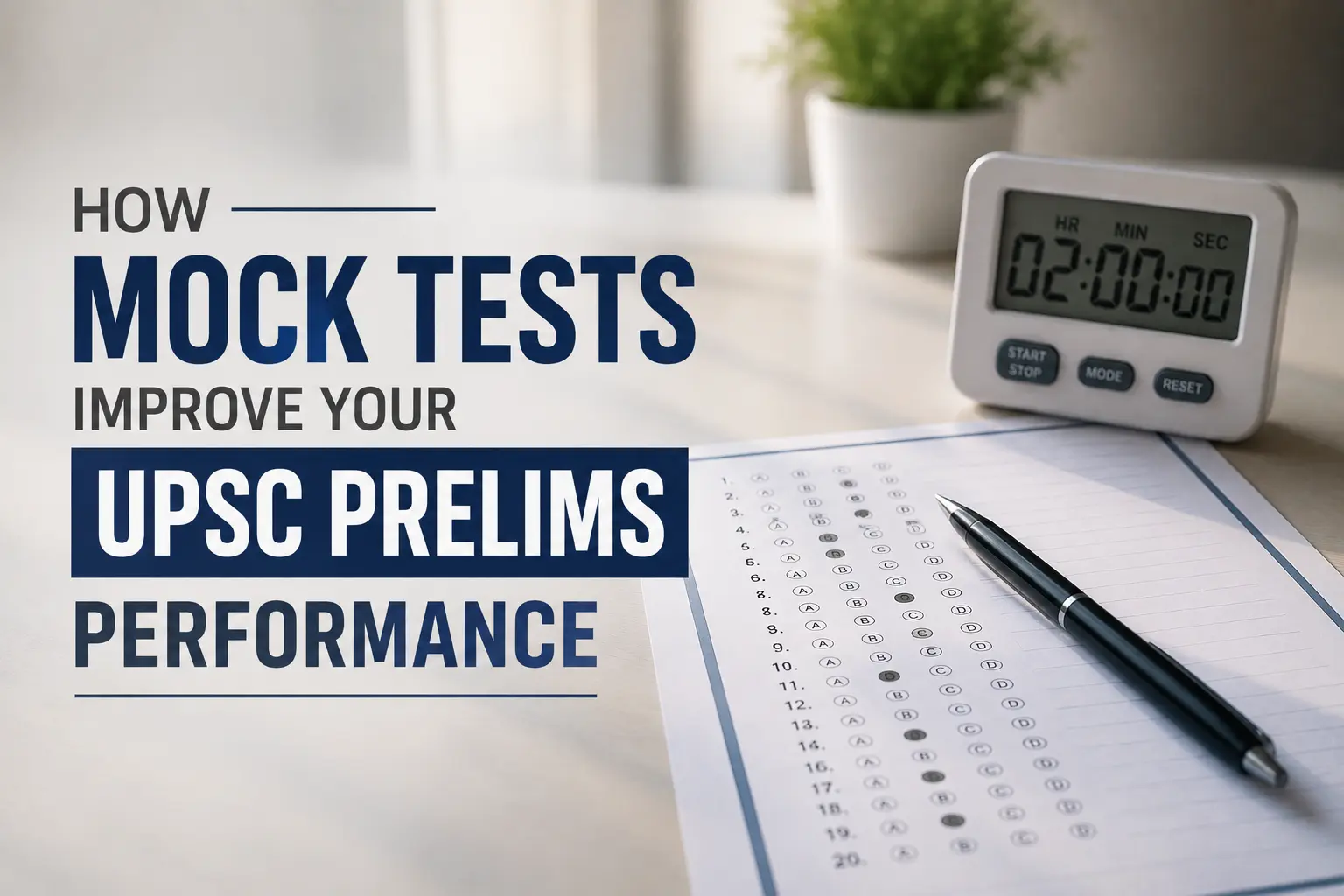
Sitting for two uninterrupted hours, solving one hundred questions, and making decisions under time constraints gradually builds mental resilience.
As the number of mock tests increases, candidates become more familiar with the examination environment.
This familiarity reduces anxiety and allows them to think more clearly on the day of the actual examination.
How many full-length mock tests should I attempt before the Prelims?
There is no fixed number that guarantees success. The focus should be on attempting enough tests to become comfortable with the exam pattern while thoroughly analysing each one. A smaller number of well-reviewed tests is often more beneficial than attempting many tests without proper evaluation.
Identify Your Strong and Weak Areas
Mock tests provide a realistic picture of your preparation.
You may believe that you are strong in History but consistently lose marks in Ancient India. Similarly, you may assume Environment is difficult until repeated tests reveal it to be one of your strongest subjects.
Such insights help you revise more efficiently.
Instead of distributing equal time across every subject, you can focus additional attention on areas that genuinely require improvement.
This targeted revision makes preparation more effective.
Improve Your Decision-Making Skills
One of the defining characteristics of successful UPSC candidates is sound judgment.
Every Prelims paper contains questions that are easy, moderately difficult, and highly challenging.
Mock tests teach aspirants how to make smart decisions by helping them:
- Identify straightforward questions quickly.
- Avoid spending excessive time on difficult ones.
- Decide when to attempt a question.
- Recognize when leaving a question unanswered is the wiser choice.
These decisions often influence the final score as much as subject knowledge.
Simulate the Real Examination
As the Preliminary Examination approaches, try to recreate actual exam conditions while attempting mock tests.
Choose a quiet environment, follow the official examination timing, avoid interruptions, and complete the paper in one sitting.
Practising under realistic conditions helps improve:
- Concentration.
- Mental endurance.
- Time management.
- Confidence.
It also reduces the chances of feeling overwhelmed during the actual examination.
Should I revise before attempting every mock test?
Not necessarily. Some mock tests are meant to assess your current level of preparation. Attempting a few tests without immediate revision can help identify topics that genuinely need more attention.
Common Mistakes Aspirants Make with Mock Tests
Mock tests are highly effective only when used correctly.
Some common mistakes include:
- Focusing only on scores instead of learning.
- Ignoring post-test analysis.
- Attempting too many tests without revising.
- Becoming discouraged after low marks.
- Constantly comparing scores with other aspirants.
- Changing study strategies after every test.
Remember, mock tests are tools for improvement, not measures of your potential.
Students preparing under the guidance of an experienced IAS Academy often receive detailed feedback after mock examinations, helping them understand not only what went wrong but also why those mistakes occurred and how they can be corrected before the actual examination.
Stay Consistent Instead of Chasing High Scores
Many aspirants become excited after one good mock test or discouraged after one poor performance.
Neither reaction is helpful.
Performance naturally fluctuates during preparation.
What matters is whether your understanding, accuracy, and confidence improve steadily over several weeks.
A gradual upward trend is a much better sign than occasional high scores followed by inconsistent performance.
Mock tests should encourage continuous learning rather than emotional highs and lows.
What if my mock test scores remain low despite regular practice?
Low scores should be viewed as feedback rather than failure. Review your mistakes carefully, strengthen weak subjects, revise consistently, and continue practising. Many successful UPSC candidates initially scored poorly in mock tests but improved steadily through regular analysis and disciplined preparation.
Conclusion
Mock tests are far more than practice papers, they are one of the most effective tools for preparing for the UPSC Preliminary Examination.
They help aspirants understand the examination pattern, improve time management, strengthen conceptual clarity, develop intelligent question-selection strategies, and build the confidence needed to perform under pressure.
Most importantly, they transform mistakes into opportunities for learning. Every incorrect answer analysed today reduces the chances of repeating the same mistake in the actual examination.
Rather than fearing low scores, aspirants should embrace mock tests as an essential part of their preparation journey. With regular practice, thoughtful analysis, and consistent revision, mock tests become a powerful stepping stone toward clearing the UPSC Preliminary Examination and moving confidently to the next stage of the Civil Services Examination.