
For many UPSC aspirants, current affairs are the most intimidating part of the preparation journey. Unlike subjects such as History or Geography, there is no clear beginning or end. Every morning brings fresh headlines, policy updates, international developments, economic changes, scientific discoveries, and government initiatives. Before long, many aspirants feel they are constantly reading but never actually completing anything.
Take the example of Sneha, a first-time UPSC aspirant. Determined to stay updated, she subscribed to two newspapers, several monthly magazines, multiple YouTube channels, and countless Telegram groups. Every day began with current affairs and ended with current affairs. After three months, she realized she was spending almost six hours reading news but struggling to revise even the basics of the General Studies syllabus.
This experience is surprisingly common. The problem is rarely a lack of effort, it is trying to consume more information than the examination actually demands.
The good news is that UPSC does not expect candidates to remember every news article published throughout the year. It expects them to understand important issues, connect them with the syllabus, and develop analytical thinking. Once aspirants understand this difference, current affairs become far more manageable.
Why Current Affairs Feel So Difficult
Unlike school examinations, UPSC does not ask questions based solely on facts or headlines. Instead, it tests whether an aspirant understands the significance of an issue.
For example, reading about a new environmental policy is only the beginning. The examination may also require knowledge of constitutional provisions, environmental laws, international agreements, biodiversity, or government schemes related to that topic.
This is why many students feel overwhelmed. They try to memorize every article instead of understanding the broader concept behind it.
A better approach is to focus on learning rather than collecting information.
Start with One Reliable Newspaper
One of the biggest mistakes beginners make is reading multiple newspapers every day.
Many believe that covering two or three newspapers will improve their preparation. In reality, it often leads to unnecessary repetition and information overload.
Choose one reliable newspaper and read it consistently.
While reading, concentrate on topics related to:
- Governance
- Polity
- Economy
- Environment
- International Relations
- Science and Technology
- Social Issues
At the same time, avoid spending excessive time on political debates, celebrity news, local crime reports, or entertainment stories unless they have broader national importance.
Reading with the UPSC syllabus in mind is far more effective than reading every page from beginning to end.
How much time should I spend reading the newspaper every day?
Most aspirants can comfortably complete newspaper reading in about one hour. Spending significantly more time often reduces the time available for static subjects and revision.
Learn to Connect Current Affairs with Static Subjects
One of the defining characteristics of successful UPSC preparation is the ability to connect current events with static concepts.
Suppose a newspaper discusses a cyclone affecting India’s eastern coast.
Instead of only remembering the news, ask yourself:
- Which geographical conditions cause cyclones?
- Which government agencies manage disasters?
- Which constitutional provisions relate to disaster management?
- How does climate change influence such events?
This habit transforms ordinary news into meaningful preparation.
Do Not Make Notes on Everything
Many beginners spend hours creating detailed current affairs notebooks.
While note-making is useful, writing down every article often becomes counterproductive.
Instead, make concise notes only when an issue is:
- Directly related to the UPSC syllabus
- Important for multiple subjects
- Likely to remain relevant for several months
- Supported by government reports or official data
Short notes are easier to revise and prevent unnecessary duplication.
Remember that your notes should simplify revision, not create another textbook.
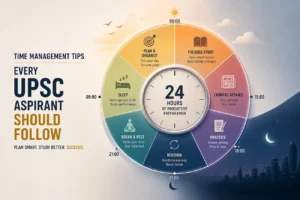
Follow a Daily Routine You Can Sustain
One reason aspirants burn out is trying to complete too much every day.
Instead of dedicating half the day to current affairs, create a balanced routine.
A practical schedule might include:
- One hour for newspaper reading
- Fifteen to twenty minutes for updating notes
- Time for static subjects
- Revision of previously studied topics
This approach ensures that current affairs remain an important part of preparation without dominating your entire study schedule.
Should I make handwritten notes or digital notes for current affairs?
Both methods work well. Choose the format that allows you to revise quickly and update information easily. The best note-taking system is the one you consistently maintain throughout your preparation.
Avoid the Trap of Too Many Sources
The internet has made UPSC preparation more accessible than ever before.
Unfortunately, it has also made distractions more common.
Many aspirants begin every day with one YouTube analysis, followed by a Telegram PDF, a coaching institute’s compilation, and several social media updates discussing the same topic.
This habit creates confusion rather than clarity.
Choose a limited number of reliable sources and trust them. Consistency with a few quality resources almost always produces better results than trying to follow everything available online.
Remember That Revision Is More Important Than Collection
Some aspirants proudly maintain folders filled with current affairs magazines, newspaper cuttings, and online PDFs.
However, if these resources are never revised, they provide little value.
Current affairs become useful only when they can be recalled during the examination.
Instead of constantly downloading new material, dedicate regular time to revising the notes you have already prepared.
By doing so, important issues remain fresh in your memory and become easier to apply in both Prelims and Mains.
The first step towards mastering current affairs is understanding that UPSC is not testing your ability to read everything, it is testing your ability to understand what truly matters.
Use Monthly Magazines as Revision Tools
One mistake many aspirants make is treating monthly current affairs magazines as their primary source of information.
These compilations are valuable, but they should support, not replace daily newspaper reading.
Monthly magazines help consolidate important events and make revision more organized. They are particularly useful during the months leading up to the Preliminary Examination because they present major developments in a structured format.
However, avoid reading multiple magazines covering the same content. One reliable compilation is generally sufficient if you revise it consistently.
Follow Authentic Government Sources
Not every piece of information on the internet is equally reliable.
Whenever possible, refer to official government sources for important schemes, policies, reports, and initiatives. Authentic information not only improves your understanding but also adds credibility to your answers in the Mains examination.
Government websites, PIB releases, Economic Survey highlights, and the Union Budget are valuable resources when studied selectively.
The key word here is selectively. You do not need to read every document in detail. Focus only on information that aligns with the UPSC syllabus.
Is reading PIB every day compulsory for UPSC?
No. PIB is a useful source, but reading every press release is unnecessary. Concentrate on important government initiatives, policies, welfare schemes, reports, and announcements that are relevant to the syllabus.
Current Affairs Are Equally Important for Mains
Many aspirants mistakenly believe that current affairs are useful only for clearing the Preliminary Examination.
In reality, they play an even bigger role in the Mains examination.
Whether you are writing about agriculture, education, climate change, healthcare, women empowerment, or international relations, incorporating recent examples strengthens your answers and demonstrates a better understanding of contemporary issues.
Instead of memorizing isolated facts, develop the habit of collecting relevant examples that can be used across multiple subjects.
This approach makes your answers more balanced, analytical, and practical.
Learn to Filter Information
One of the most valuable skills for a UPSC aspirant is knowing what not to study.
Every headline does not deserve equal attention.
When reading the news, ask yourself a few simple questions:
- Is this topic mentioned in the UPSC syllabus?
- Does it have national or international significance?
- Can it be connected with General Studies?
- Is it likely to remain relevant over the coming months?
If the answer is “no,” it is perfectly acceptable to move on.
Filtering information effectively saves valuable study time and prevents unnecessary stress.
Integrate Current Affairs into Answer Writing
Current affairs become truly useful only when they improve your answers.
For example, if a Mains question asks about water conservation, mentioning a recent government initiative or successful state-level programme immediately makes the answer more relevant.
Similarly, discussions on renewable energy, digital governance, public health, or artificial intelligence can often be supported with recent developments.
Rather than maintaining separate notebooks for every topic, try adding important current examples to your existing General Studies notes. This creates a stronger connection between static and dynamic portions of the syllabus.
Students preparing under the guidance of an experienced IAS Academy are often encouraged to practice this integration regularly, as it helps improve both answer quality and analytical thinking.
How can I remember current affairs for both Prelims and Mains?
Instead of memorizing individual news items, revise them according to subjects such as Polity, Economy, Environment, Science and Technology, and International Relations. Subject-wise revision makes information easier to retain and apply during the examination.
Common Mistakes to Avoid
Even aspirants with good study habits sometimes struggle because of avoidable mistakes.
Some of the most common ones include:
- Following too many YouTube channels for daily news analysis.
- Making excessively detailed notes that are difficult to revise.
- Ignoring static subjects while focusing only on current affairs.
- Reading news without relating it to the UPSC syllabus.
- Spending hours collecting PDFs instead of revising existing material.
- Trying to memorize facts instead of understanding concepts.
Avoiding these habits makes current affairs preparation much more manageable.
Build a Sustainable Routine
Current affairs should become a habit rather than a burden.
Instead of trying to complete everything in one sitting, dedicate a fixed amount of time every day. Small, consistent efforts over several months produce far better results than occasional marathon study sessions.
Remember that UPSC preparation is not a race to consume the most information. It is a process of understanding important issues, thinking critically, and applying knowledge effectively during the examination.
Can I prepare current affairs in the last three months before the UPSC exam?
Current affairs require continuous learning throughout the year. While revision becomes especially important in the final months, relying entirely on last-minute preparation often makes it difficult to understand the context behind important issues.
Conclusion
Preparing current affairs for UPSC does not have to feel overwhelming. The challenge is not the volume of news available but learning how to separate what is important from what is unnecessary.
By choosing reliable sources, limiting study materials, connecting current events with static subjects, making concise notes, and revising consistently, aspirants can build a strong command over current affairs without sacrificing the rest of their preparation.
The goal is not to remember every headline published during the year. The goal is to develop a deeper understanding of the issues that shape governance, society, the economy, science, and international relations.
With a structured approach, disciplined revision, and the habit of learning a little every day, current affairs gradually become one of the strongest aspects of UPSC preparation rather than the most stressful.