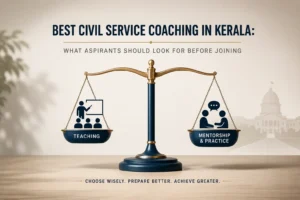
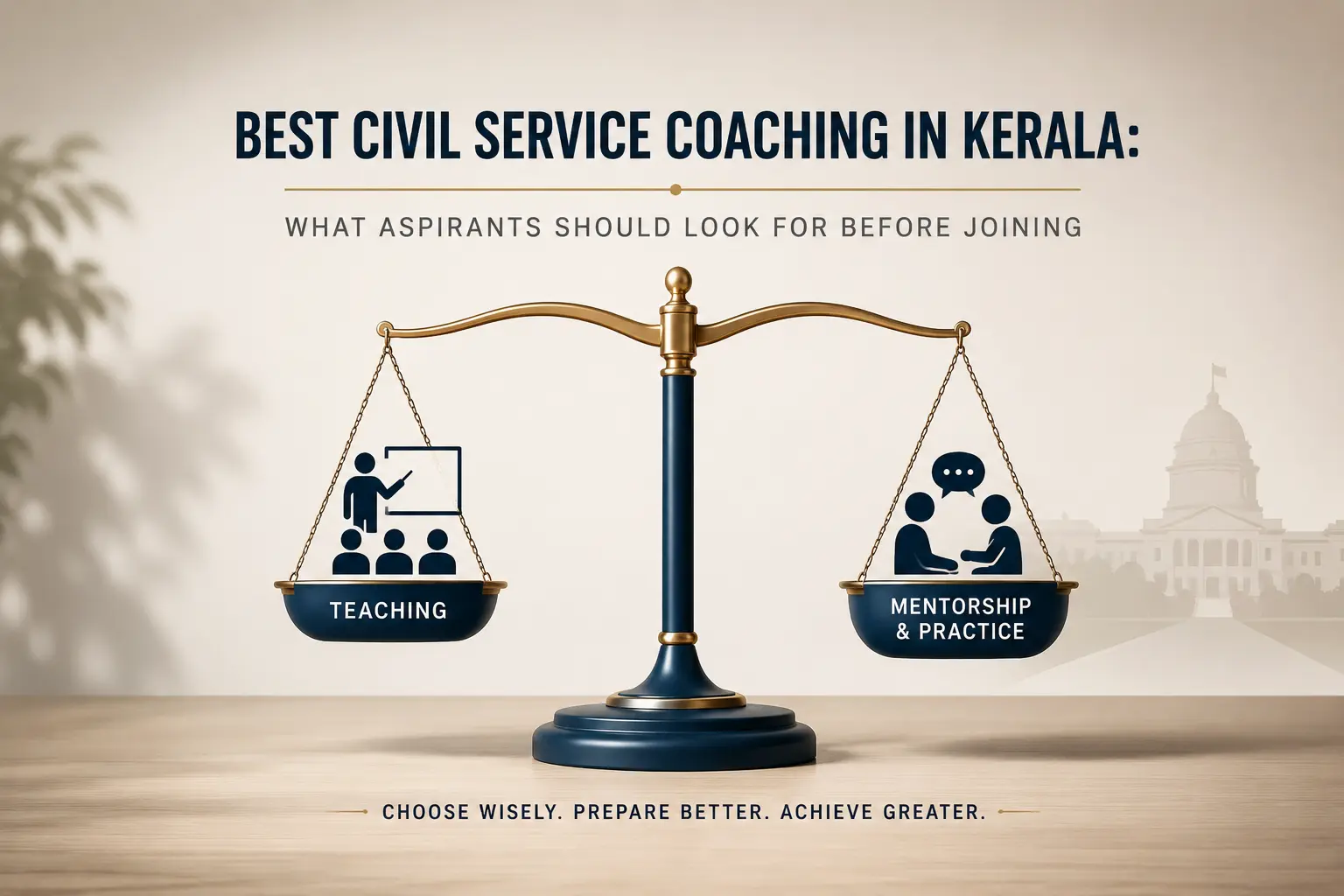
Choosing the right coaching institute can be one of the most important decisions for an aspirant preparing for the Civil Services Examination. Kerala has several institutes offering UPSC preparation, giving students plenty of choices. However, having more options can also make the decision more difficult.
Most coaching institutes highlight experienced faculty, study materials, test series, mentorship, and successful candidates. While these factors are important, aspirants should look beyond promotional claims before enrolling. The right institute should provide more than classroom lectures. It should help students understand the examination, develop effective study habits, practise consistently, identify weaknesses, and improve their performance over time.
Before choosing a civil service coaching institute, aspirants should therefore consider several practical factors.
Understand Your Own Preparation Needs
The first step is to understand what you expect from coaching.
A beginner may need strong foundational teaching and guidance on how to approach the UPSC syllabus. An aspirant preparing for another attempt may already understand the basics and instead need help with answer writing, revision, mock tests, or correcting mistakes from a previous attempt.
A working professional may require flexible schedules, while a full-time aspirant might prefer an intensive classroom programme.
This means there is no single coaching model that is perfect for everyone. The ideal choice depends on an individual’s preparation level, learning style, available time, and specific weaknesses.
Evaluate the Faculty
Faculty members have a direct influence on the quality of classroom learning. Therefore, aspirants should find out who will actually be teaching their subjects.
Experienced faculty should be able to simplify complex concepts, explain topics from an examination perspective, connect current affairs with the syllabus, and encourage analytical thinking.
It is also useful to attend a demo class whenever possible. This gives students an opportunity to experience the teaching style instead of relying only on advertisements or testimonials.
A good teacher should not merely provide information. They should help students understand how to use that information when answering examination questions.
Examine the Teaching Methodology
Completing the syllabus is not the same as preparing effectively for the Civil Services Examination.
A strong teaching methodology should help students understand concepts, analyse issues, connect different subjects, and apply their knowledge to Prelims and Mains questions.
Aspirants should ask whether classes include previous-year question analysis, discussions, current-affairs integration, doubt-clearing sessions, and examination-oriented practice.
The teaching approach should make the syllabus more manageable rather than simply increasing the amount of information students have to remember.
Check the Quality of Study Materials
Good study material can save aspirants a significant amount of time. However, more material does not necessarily mean better preparation.
Students should check whether the institute provides organized resources that correspond with the UPSC syllabus. Materials should ideally support conceptual understanding, revision, and examination practice.
It is also important to find out how frequently current-affairs resources are updated. Outdated material can create unnecessary confusion, particularly when contemporary developments need to be connected with static subjects.
A useful resource system should help students identify what they actually need to study instead of encouraging them to collect multiple books and notes.
Evaluate the Test Series
Regular testing is an important part of UPSC preparation. Mock tests allow aspirants to assess their knowledge and practise working under time constraints.
For Prelims, tests should help develop accuracy, question interpretation, elimination skills, and time management. For Mains, they should focus on answer structure, relevance, analytical thinking, and completing the paper within the allotted time.
However, the number of tests is not enough to determine their value. The quality of evaluation is equally important.
Aspirants should find out whether their answers are properly reviewed and whether feedback explains what needs to be improved.
Is a test series useful without detailed feedback?
A test series is much more valuable when it includes meaningful feedback. A score alone cannot explain why an aspirant lost marks. Detailed evaluation can identify issues such as poor time management, weak introductions, incomplete arguments, factual mistakes, or difficulty interpreting questions.
Regular feedback allows students to identify recurring problems and work on them before the actual examination.
Look for Personalized Mentorship
Every aspirant has different strengths and weaknesses. Some may struggle with particular subjects, while others may have difficulty maintaining consistency or managing their study time.
Personalized mentorship can help address these individual challenges.
A mentor can review an aspirant’s progress, analyse test performance, suggest changes to the study schedule, and identify areas that need additional attention.
Good mentorship should not simply consist of motivational discussions. It should provide practical academic guidance based on the student’s actual performance.
This becomes particularly useful when an aspirant feels uncertain about whether their preparation strategy is working.
Can mentorship really make a difference in UPSC preparation?
Yes, particularly when the guidance is specific to the aspirant. A mentor can identify problems that students may not recognize themselves and suggest targeted improvements.
For example, an aspirant may spend several hours studying but still perform poorly because they are not revising effectively. Another may understand the syllabus but struggle to express ideas in Mains answers. Individual feedback can help identify these differences and provide a more appropriate strategy.
Assess Current-Affairs Preparation
Current affairs are an important component of civil service preparation, but simply reading newspapers or daily updates is not enough.
A good coaching programme should teach students how to identify important developments, understand their background, and connect them with the static syllabus.
For example, an issue related to environmental policy may have relevance to geography, ecology, governance, economics, and essay writing.
Students should therefore look for an institute that teaches them how to analyse current events rather than simply memorize headlines.
Consider Prelims and Mains Together
Aspirants should also understand how the institute approaches Prelims and Mains preparation.
Although the two stages test different skills, preparation can be integrated. Strong conceptual knowledge supports both stages, while answer writing can improve analytical thinking and retention.
An institute that focuses entirely on completing the Prelims syllabus may leave students with insufficient time to develop Mains-oriented skills.
A balanced approach should gradually introduce students to both objective and descriptive examination requirements.
Examine Optional Subject Support
The optional subject deserves careful consideration because it contributes significantly to the Mains score.
Before enrolling, aspirants should check whether the institute provides faculty support, study materials, previous-year question analysis, answer-writing practice, and tests for the relevant optional subject.
However, students should not choose an optional merely because coaching is available for it. Personal interest, academic background, familiarity with the subject, and availability of resources should all be considered.
Don’t Choose an Institute Only Because of Its Results
Results can provide useful information, but they should not be the sole basis for choosing a coaching institute.
Aspirants should look at the overall learning experience. Faculty quality, teaching methodology, test evaluation, mentorship, study resources, and student support can reveal more about an institute’s value than a single success statistic.
Speaking with current or former students can also provide useful insight into the actual classroom and mentoring experience.
Consider Location and Learning Environment
For students choosing offline coaching, location matters.
A long daily commute can consume valuable time that could otherwise be spent studying, revising, or practising questions. Aspirants should therefore consider how easily they can travel to the institute and whether the classroom environment supports focused learning.
Students considering online or hybrid programmes should evaluate recorded lectures, digital study materials, technical support, and doubt-solving facilities.
The most effective programme is one that an aspirant can follow consistently without creating unnecessary logistical difficulties.
Consider the Overall Value of the Programme
Fees are naturally an important consideration, but they should be evaluated alongside what the programme actually provides.
The most expensive coaching programme is not automatically the best. Similarly, a low-cost programme may not provide sufficient academic support.
Aspirants should compare what is included in the fee, such as classroom instruction, study materials, mock tests, answer evaluation, mentorship, recorded lectures, and doubt-clearing sessions.
The goal should be to find a programme that provides genuine educational value rather than simply choosing based on price.
Should an aspirant attend a demo class before joining?
Yes. A demo class can help students understand the teaching style, pace, clarity of explanation, and level of classroom interaction. It is also useful to review sample study materials and ask existing students about their experiences.
Making these checks before enrollment can prevent students from committing to a programme that does not match their expectations.
Why Individual Guidance Matters
Civil service preparation can become overwhelming because of the size of the syllabus and the amount of available study material. Without proper direction, aspirants may spend too much time on certain topics, repeatedly change resources, or postpone important areas such as revision and answer writing.
Individual guidance can help bring structure to this process.
For aspirants exploring IAS Courses, the important question is not simply whether an institute provides classes. Students should consider whether it offers the combination of structured teaching, examination-focused practice, feedback, mentorship, and academic support needed for long-term preparation.
Conclusion
Selecting the right civil service coaching institute in Kerala requires careful evaluation. Aspirants should examine faculty quality, teaching methodology, study materials, test series, answer evaluation, mentorship, current-affairs preparation, optional-subject support, location, and overall value.
Most importantly, coaching should support an aspirant’s preparation rather than replace personal effort. Consistent self-study, revision, practice, and self-evaluation remain essential regardless of which institute a student chooses.
The best coaching environment is one that provides clarity, direction, meaningful feedback, and the right academic support while helping aspirants gradually become more independent learners.
Taking the time to compare these factors before joining can help students make a more informed decision and begin their Civil Services preparation with greater confidence and purpose.
ow to use that foundation effectively.
The greatest advantage of mentorship is its focus on the individual. Instead of assuming that every aspirant should follow the same strategy, it recognizes differences in academic background, preparation level, learning speed, strengths, and weaknesses.
With regular feedback, realistic planning, targeted improvement, accountability, and objective guidance, aspirants can make better use of their preparation time.
For a competitive examination as demanding as UPSC, knowing what to study is only the beginning. Knowing how to study, when to revise, how to practice, where to improve, and when to change direction can make the journey significantly more effective. Personalized mentorship provides the individual guidance needed to turn preparation into a more focused and purposeful process.