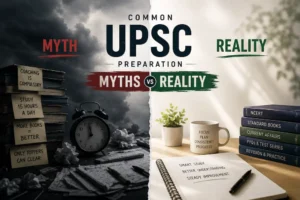
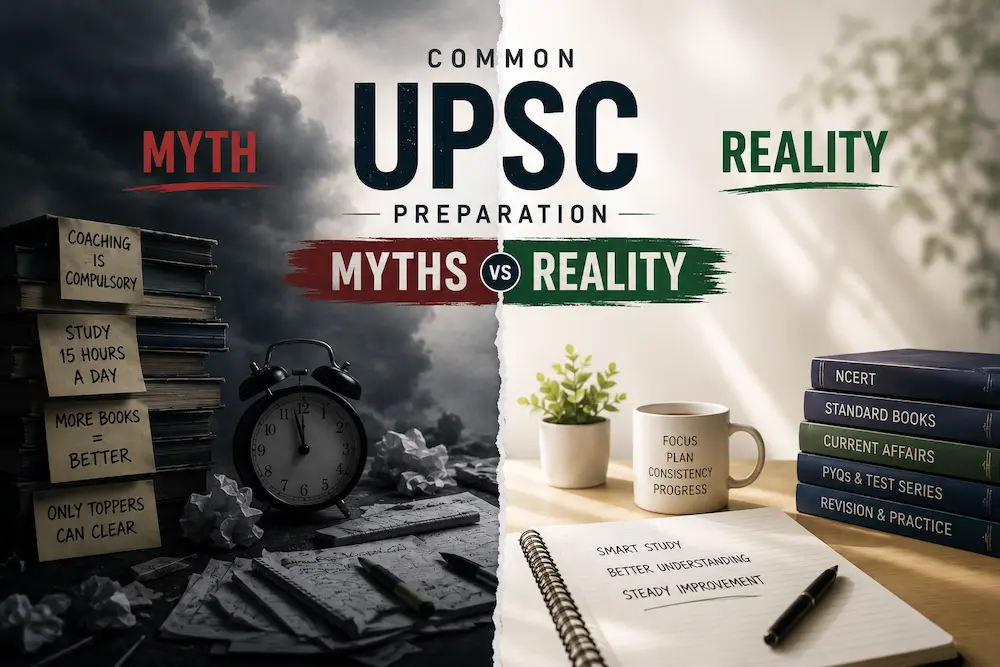
The UPSC Civil Services Examination is one of the most challenging competitive examinations in India. Its reputation, vast syllabus and highly competitive nature have created numerous assumptions about what it takes to succeed. Aspirants often encounter advice from successful candidates, coaching centres, social media platforms, friends and online communities.
While some of this advice can be useful, not everything should be treated as fact. Myths about study hours, academic backgrounds, coaching, books, current affairs and examination attempts can influence preparation in unhelpful ways. Some candidates may put unnecessary pressure on themselves, while others may follow strategies that do not suit their circumstances.
Understanding the reality behind these common beliefs can help aspirants approach preparation with greater clarity.
Myth 1: Only Academic Toppers Can Clear UPSC
One common misconception is that the Civil Services Examination is meant only for students who consistently achieved excellent marks throughout their academic careers.
A strong academic record can certainly reflect discipline and learning ability, but it does not guarantee success in UPSC. The examination requires a different combination of skills, including analytical thinking, writing ability, awareness of current affairs, conceptual understanding and consistency.
Candidates with average academic records have also succeeded after developing the skills required for the examination. Similarly, academic toppers must prepare specifically for UPSC rather than assuming that previous achievements will automatically translate into success.
School and college marks should therefore not become a measure of an aspirant’s potential.
Myth 2: Studying 15 Hours a Day Is Necessary
The belief that serious UPSC aspirants must study for 12 to 15 hours every day is extremely common. Social media often reinforces this idea through highly demanding study routines.
However, the number of hours spent at a desk does not automatically indicate the quality of preparation. Concentrated study, revision, practice and proper understanding are more important than simply increasing study hours.
A candidate who studies for six or seven highly productive hours may achieve more than someone who spends twelve hours reading without focus.
A realistic timetable that can be followed for several months is generally more useful than an exhausting routine that cannot be maintained.
Myth 3: Only Science and Engineering Students Have an Advantage
Another popular belief is that UPSC favours candidates with science or engineering backgrounds. This can discourage students from humanities, commerce and other academic disciplines.
The Civil Services Examination is open to graduates from different educational backgrounds, subject to the prescribed eligibility conditions. Each academic stream can offer certain advantages.
A humanities graduate may have familiarity with subjects such as history or political science. An engineering graduate may possess strong analytical skills, while a commerce graduate may already understand several economic concepts.
However, no academic stream provides an automatic advantage. Every candidate must understand the UPSC syllabus and prepare according to the examination’s requirements.
Myth 4: Coaching Is Compulsory
Coaching can provide valuable support, but joining a coaching institute is not an absolute requirement for clearing UPSC.
Some candidates prefer self-study because they can create their own timetable and select resources independently. Others perform better when they have structured classes, regular tests, mentorship and external guidance.
The right choice depends on individual learning habits, preparation level and ability to remain disciplined.
For candidates who prefer structured guidance, an IAS Academy Trivandrum can provide an organised learning environment and preparation support. However, coaching itself cannot guarantee selection. Personal study, revision, practice and continuous evaluation remain essential.
Myth 5: More Books Lead to Better Preparation
UPSC aspirants have access to an enormous amount of study material. This sometimes creates the belief that successful candidates must have read a large number of books.
In reality, excessive resources can become a disadvantage. Reading multiple books on the same topic may leave little time for revision and question practice.
A carefully selected set of reliable resources is usually more useful than a huge collection that remains incomplete.
Candidates should also use previous-year question papers to determine what deserves attention. Study material should help build understanding and improve the ability to answer questions rather than simply increase the number of pages covered.
Myth 6: Every Current Affair Must Be Memorised
Current affairs are an important part of UPSC preparation, but candidates do not need to remember every news story.
The examination often expects candidates to connect contemporary events with larger subjects such as governance, economy, environment, international relations, science and social development.
Reading several newspapers and websites throughout the day can consume valuable preparation time. Instead, aspirants should identify significant issues and understand their background, importance, challenges and possible solutions.
This approach is more useful than memorising isolated facts because it allows current affairs to be applied to analytical answers.
Is reading a newspaper every day compulsory for UPSC preparation?
A newspaper can be a useful source, but it is not the only method of following current affairs. Candidates can use a reliable newspaper, a quality current-affairs compilation or another suitable source. The important thing is to understand and revise relevant issues instead of spending excessive time consuming multiple sources.
Myth 7: The Optional Subject Must Match Graduation
Many aspirants believe that the optional subject must be related to their college degree. This is not necessarily true.
Candidates should evaluate optional subjects based on factors such as interest, familiarity with the syllabus, availability of resources and comfort with the subject’s question pattern.
Choosing a subject simply because it was studied during graduation does not guarantee better performance. At the same time, selecting a completely unfamiliar subject without researching its syllabus may create additional challenges.
The best approach is to examine the syllabus and previous-year papers before making a decision.
Myth 8: Clearing Prelims Means the Difficult Part Is Over
Clearing the Preliminary Examination is a major milestone, but it does not mean that the rest of the examination is easy.
The Main Examination requires extensive written preparation. Candidates must handle General Studies papers, Essay and the optional subject while demonstrating analytical thinking and effective written communication.
The Personality Test evaluates another set of qualities, including awareness, judgement, confidence and communication.
Each stage requires a different preparation approach. Clearing one stage should therefore be viewed as progress towards the next stage rather than the end of the difficult part.
Myth 9: Every Successful Candidate Uses the Same Strategy
UPSC success stories can be motivating, but copying another candidate’s strategy word for word is rarely practical.
Aspirants have different educational backgrounds, strengths, weaknesses, responsibilities and available study hours. A strategy that works well for one person may not suit another.
One candidate may require additional time for building basic concepts, while another may need to focus more heavily on answer writing or mock tests.
Successful candidates’ experiences can provide useful ideas, but those ideas should be adapted to individual requirements rather than copied without modification.
Myth 10: An Attempt Should Be Taken Only After Perfect Preparation
Some aspirants continuously postpone an attempt because they believe their preparation is never complete enough.
Thorough preparation is important, but perfection is almost impossible. Previous-year questions, mock tests and actual examination experience can reveal weaknesses that are difficult to identify through studying alone.
However, an attempt should still be a carefully considered decision based on eligibility, preparation level and individual circumstances.
Candidates should neither appear simply because others are doing so nor keep postponing indefinitely while waiting to feel completely prepared.
Does failing one UPSC attempt mean future attempts are unlikely to succeed?
No. An unsuccessful attempt does not determine the result of future attempts. What matters is whether the candidate identifies weaknesses and changes ineffective aspects of preparation. Analysing performance honestly can help improve strategy, revision methods and examination technique in subsequent attempts.
Myth 11: Serious Aspirants Must Give Up Everything Else
UPSC preparation demands commitment, but it does not require candidates to eliminate every activity outside studying.
Giving up sleep, exercise, family time and reasonable recreation can eventually lead to exhaustion. Since preparation often continues for many months, maintaining physical and mental well-being is important.
Aspirants should instead establish boundaries around non-study activities. Leisure can remain part of the routine as long as it does not consistently interfere with study targets.
Candidates who have jobs, college commitments or family responsibilities can also prepare for UPSC. Their schedules may need to be different from those of full-time aspirants, but realistic planning can make steady preparation possible.
Can UPSC preparation be managed alongside work or other responsibilities?
Yes. Candidates with limited study time may need a longer preparation period, but consistent effort can still produce meaningful progress. The schedule should be designed around actual availability instead of copying the routine of someone studying full-time. Prioritisation becomes particularly important when preparation has to fit around other responsibilities.
Separating Myths From Reality
UPSC preparation becomes unnecessarily complicated when popular assumptions are treated as fixed rules. There is no universal number of study hours, academic background, booklist or coaching programme that guarantees success.
What matters is understanding the examination requirements and building a strategy around them. Relevant resources, regular revision, answer-writing practice, current-affairs awareness and analytical thinking all play important roles.
Aspirants should also be careful when comparing themselves with candidates featured in online success stories. Such stories can provide motivation and useful insights, but individual preparation journeys are rarely identical.
The Civil Services Examination is undoubtedly demanding, but understanding what it actually requires can make preparation more practical. Instead of chasing extreme routines or constantly changing strategies, candidates can focus on consistent learning, regular evaluation and gradual improvement.
Replacing myths with realistic expectations allows aspirants to approach the examination with greater confidence, discipline and clarity.